Japanese vs Korean Noodles: Ramen vs Ramyeon, What’s Trending in North America, and How to Cook Both at Home
Published: Jan 28, 2026/ Last Updated:Jan 28, 2026
- 14 min read
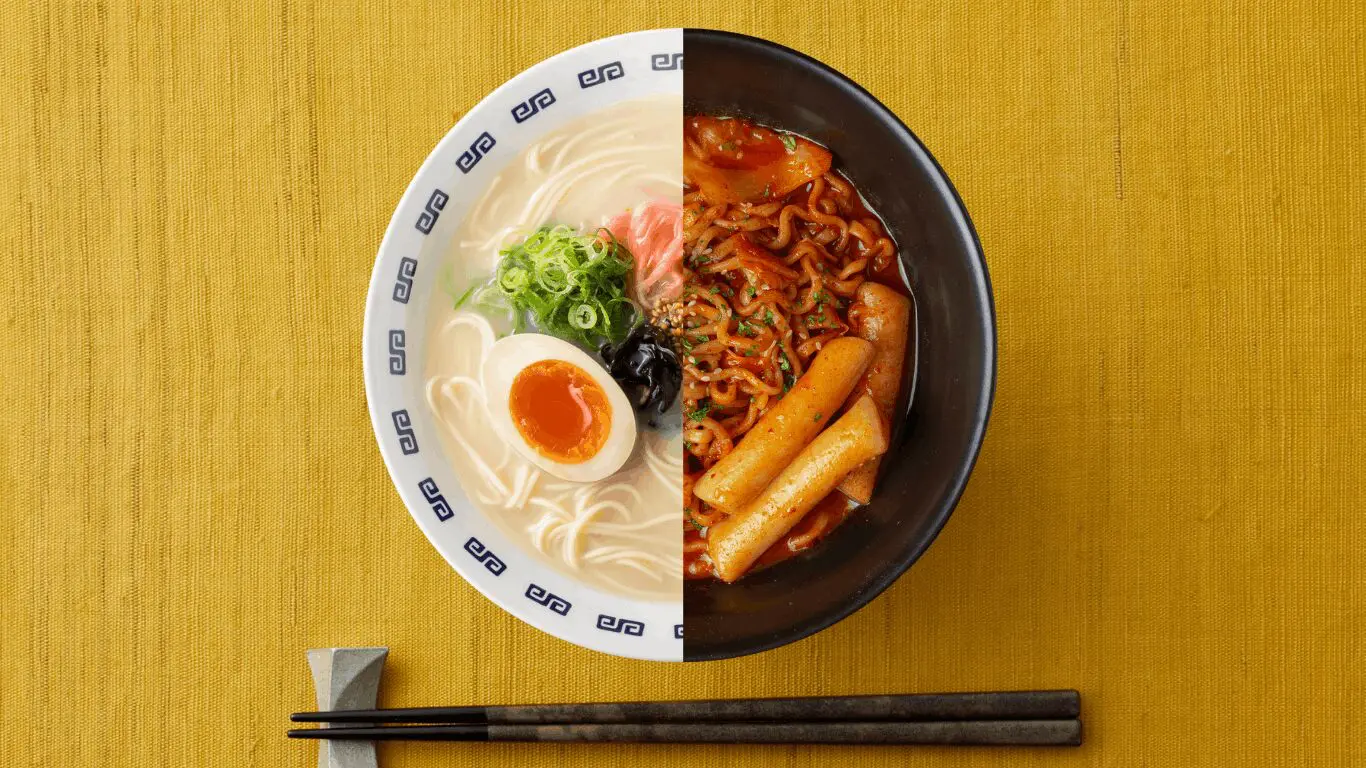
Walk down the noodle aisle in North America today and you’ll notice something new: shoppers are no longer choosing between “cup noodles” and “ramen” as a single category. They compare countries, heat levels, textures, and even the culture behind the bowl.
Japanese noodles (often grouped as ramen, udon, yakisoba, and more) tend to be associated with deep umami, regional variety, and restaurant craftsmanship. Korean noodles, on the other hand, are increasingly associated with bold spice, addictive sweet-salty seasoning, and social-media-friendly “challenge” energy.
This blog compares Japanese and Korean noodle products through a North American lens, then brings it back to what most readers care about: what to cook tonight, and how can you make it taste great at home?
*Important note on terminology: In Korea, “ramyeon” usually refers to instant noodles, while in the U.S. people often say “Korean ramen” even when they mean “Korean ramyeon.” We will use ramen vs ramyeon carefully, but we’ll also acknowledge the American habit of blending the terms.
- Index
- Why Japanese vs Korean noodles is a hot topic in North America right now
- Why Japanese noodles are rising in parallel (ramen restaurants, regional variety, and fresh noodles at home)
- Why are Korean noodles surging? (spice + social media + Korean culture exports)
- J-Noodles 101: what makes Japanese noodles different
- K-Noodles 101: what makes Korean noodles different
- Mutual influence: how Japanese and Korean noodle cultures shape each other
- Myojo USA Kitchen: Japanese noodles with Korean-inspired twists
- Conclusion and where to buy Myojo USA noodles
■Why Japanese vs Korean noodles is a hot topic in North America right now
North America’s noodle demand is being pulled by two forces at once: (1) a steady rise in overall Asian noodle consumption and at-home experimentation, and (2) a sharp acceleration in Korean-brand visibility driven by spicy flavors and social media.
Meanwhile, Japanese noodles are gaining renewed attention as restaurant ramen remains mainstream in major U.S. cities, and as “upgrade culture” pushes home cooks to seek better texture than the typical fried, shelf-stable brick of noodles.
The big picture: Asian noodles are growing, and instant noodles are going premium
Instant noodles are not a niche food. On a global basis, consumption is massive, and the U.S., Japan, and South Korea sit near the top of the demand rankings. In 2024, WINA’s demand table lists Japan at about 5.9 billion servings, the U.S. at about 5.1 billion, and South Korea just over 4.0 billion.
What is changing is not simply how many noodles people eat, but why do people buy them. In North America, shoppers increasingly treat noodles as a customizable base—something you can upgrade with eggs, vegetables, proteins, aromatics, chili oils, or even creamy sauces.
That shift benefits both Japanese and Korean noodle styles:
- Japanese-style bowls benefit when people care about noodle quality and texture, and when they want umami-forward flavor that tastes “restaurant-like.
- Korean-style bowls benefit when people want intensity—heat, sweetness, savory punch—and quick gratification.
Retailers respond to what shopper’s search, share, and repurchase. Asian supermarkets continue to be the deepest source of variety, but mainstream channels now participate more directly. Costco, for example, actively merchandises Korean noodle products (including spicy Samyang varieties), which is one of the clearest retail signals that Korean noodles have crossed beyond specialty stores.
At the same time, premium grocers like Whole Foods list ramen products in their catalog, reinforcing that “ramen” (as a meal format) has moved into the mainstream premium-grocery mindset.
Practical takeaway: If you are a U.S.-based ramen fan, you are no longer limited by access. The question is less ‘Can I find it?’ and more ‘Which style and texture do I want tonight?’
■Why Japanese noodles are rising in parallel (ramen restaurants, regional variety, and fresh noodles at home)
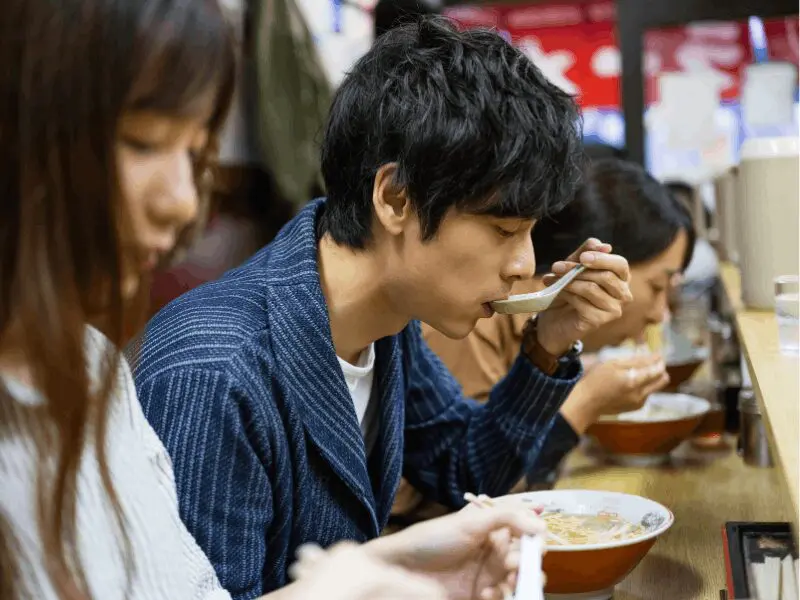
Japanese noodles are not “competing” with Korean noodles so much as growing alongside them—often within the same households.
Japanese noodles offer three benefits that map well to current U.S. cooking behavior:
- Restaurant experience
Many U.S. consumers first fall in love with ramen at a restaurant: tonkotsu, shoyu, miso, or shio ramen bowls with springy noodles and layered toppings. Once you have that baseline, you start looking for noodles that feel closer to that experience at home. - Regional and format variety
Japanese noodles more than just ramen. Udon, yakisoba, hiyashi chuka (cold ramen), and regional specialties offer variety without requiring a completely different cooking skill set. - The “texture upgrade” trend
As people upgrade their instant noodles, texture becomes one of the core elements they pay attention to. This is where fresh or non-fried noodles stand out. Fresh, non-fried noodles deliver authentic texture and restaurant-quality results at home.
In North America, this creates a simple two-lane decision:
- If you want an intense sauce and spice profile quickly, Korean ramyeon is an easy pick.
- If you want a bowl that leans into umami and noodle chew, Japanese-style noodles—especially fresh noodles—become more attractive.
The best part is that you do not need to choose one lane forever. Many of the most satisfying home bowls combine Japanese noodle texture with Korean seasoning logic. That is the exact type of cooking combination we are going to explore later in the article.
■Why are Korean noodles surging? (spice + social media + Korean culture exports)
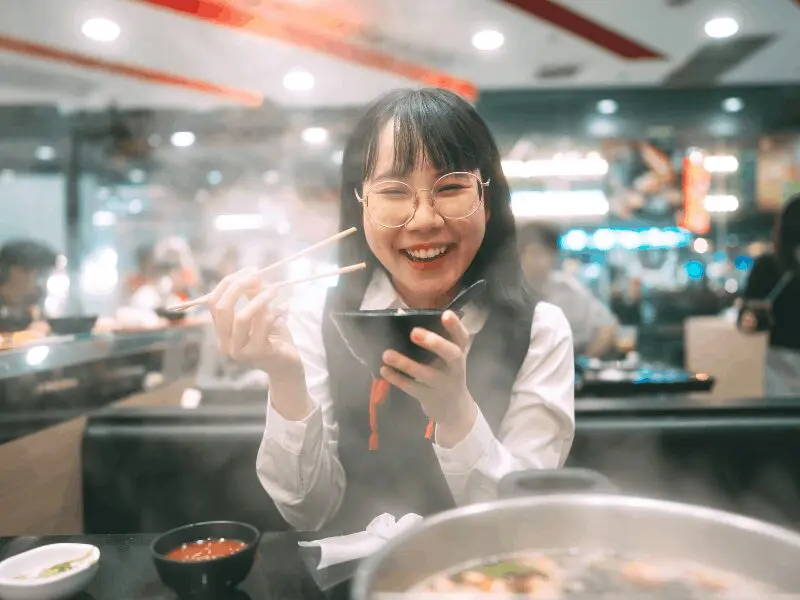
Korean noodles are experiencing a visibility boom in North America for three reinforcing reasons.
- Spice as entertainment (and identity)
Korean ramyeon brands leaned into high-heat profiles that are easy to communicate in a short video: “2x spicy,” “fire chicken,” “noodle challenge.” The heat becomes a performance.
For example, Buldak’s viral arc traces back to YouTube-era challenge culture, then scaled into short-form video posting. That matters because it turns a product into content; the product markets itself when users feel compelled to react on camera. - Korean pop culture as a distribution engine
Korean entertainment exports do not only promote Korean language and fashion; they also normalize Korean pantry items. Government and trade sources explicitly tie overseas popularity of Korean content to increased exports of Korean instant noodles. - Retail gravity
When something keeps selling well, stores usually give it more room on their shelves. Seeing Samyang Buldak noodles sold at Costco (clearly labeled as imported from South Korea) is a clear sign the product has gone mainstream—shoppers don’t see it as “only at a specialty store” anymore.
What this means for U.S. shoppers:
- If you are a heat chaser, Korean noodles reward you quickly.
- If you are a social cook, Korean noodles easily turn into a viral-looking bowl with a few toppings.
- If you are a brand explorer, Korean noodle lines are built around recognizable flavor families (spicy chicken, kimchi, stew-style, creamy-spicy).
■J-Noodles 101: what makes Japanese noodles different
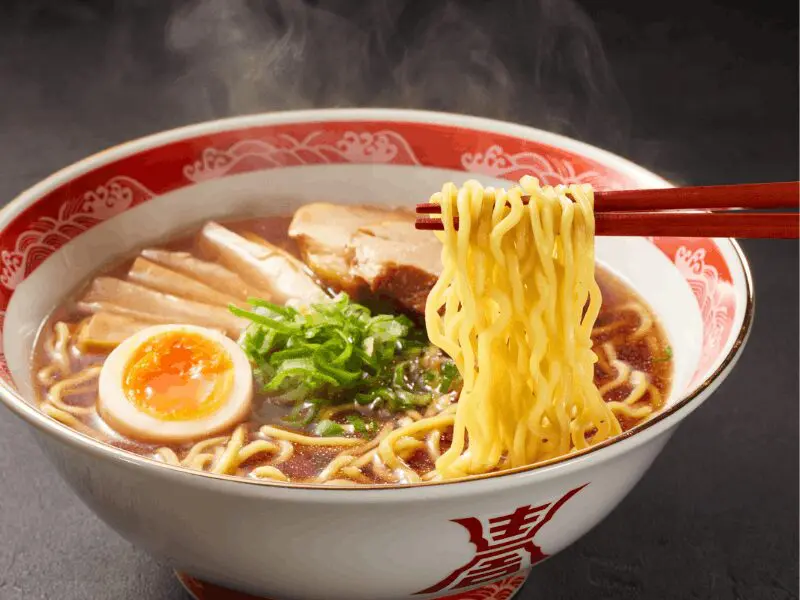
Japanese noodles are a category defined by technique and context: the type of noodle, the broth or sauce structure, and the cultural expectation that noodles should feel good to slurp—springy, elastic, and aromatic.
While there are many Japanese noodle families, ramen is the most relevant reference point for U.S.-based readers comparing to Korean ramyeon. Ramen is commonly understood as a wheat noodle served in broth, with regional variants that change soup base, seasoning, fats, and toppings.
Ingredients and texture: wheat, alkaline noodles, and that signature ‘slurpable’ bite
Most ramen noodles are made from wheat flour, water, salt, and an alkaline component (commonly referred to as kansui). That alkalinity changes both the texture and the color of the noodle, creating the springy chew people associated with restaurant ramen.
Texture is not a small detail; it is the experience. A good ramen noodle should:
- hold its bite in hot broth,
- carry soup on the surface,
- resist becoming mushy too quickly,
- and feel elastic enough to slurp.
This is one reason “fresh” noodles can matter to U.S. shoppers. Fresh or non-fried noodles can deliver a different mouthfeel than fried, shelf-stable bricks.
If you are shopping in the U.S., you will see Japanese noodles sold across formats:
- frozen or refrigerated fresh ramen noodle packs,
- shelf-stable packs with separate soup bases,
- premium bowls and cups,
- and stir-fry formats like yakisoba.
For the at-home cook, the key insight is simple: if you want a bowl that tastes closer to a ramen shop, start by improving noodle texture and then build flavor around it.
Flavor profiles: umami-forward broths and classic Japanese seasonings
Japanese noodle flavor logic often starts with umami. Instead of aiming for maximum heat, many Japanese ramen bowls emphasize layered savoriness.
Common building blocks include:
- dashi (Japanese soup stock) based on kombu or bonito,
- fermented seasonings (soy sauce/shoyu, miso),
- fats and aromas (sesame oil, scallion oil, garlic oil),
- and slow-simmered meats (pork, chicken) or vegetable broths.
Japanese ramen is also famously regional:
- Sapporo miso ramen leans hearty and savory.
- Hakata tonkotsu leans rich and creamy.
- Tokyo shoyu leans clear, aromatic, and soy-forward.
For U.S. readers, the takeaway is that Japanese noodles are often a base for “deep flavor” rather than “loud flavor.” You can still make Japanese ramen spicy, but the spice is typically one layer—not the whole identity of the bowl.
Who Japanese noodles are for in the U.S.: ramen fans, home cooks, and restaurant explorers
Japanese noodles tend to attract three overlapping U.S. audiences:
- Ramen restaurant enthusiasts
These types of people want an at-home bowl that evokes restaurant ramen: springy noodles, aromatic broth, and satisfying toppings. - Upgrade-minded instant ramen cooks
These types of people already cook instant noodles but want better texture, cleaner flavors, and more control over toppings. - Japanese food culture explorers
These types of people treat noodles as a portal into Japan’s regional foods and cooking methods.
Korean noodles are often designed to deliver a bold, finished flavor on their own.
Japanese noodles, by contrast, tend to put more emphasis on texture, making them easier to use as a base for different seasoning styles.
■K-Noodles 101: what makes Korean noodles different
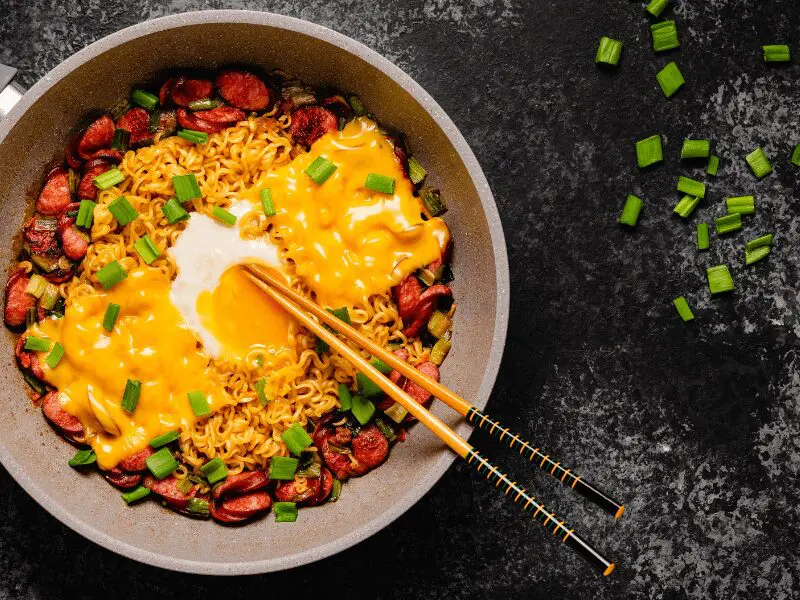
Korean noodles in North America usually center on ramyeon: convenient instant noodles designed for maximum flavor impact with minimal steps.
Korean ramyeon is not a single, uniform product, but it does share a set of recognizable characteristics: chewy noodles, potent seasoning packets, and a tendency to prioritize spice, aroma, and savory punch.
If Japanese ramen culture often starts with broth craft, Korean ramyeon culture often starts with seasoning power and customization.
Ingredients and texture: instant ramyeon, chewy noodles, and bold seasoning blends
Many Korean ramyeon products are designed as instant noodles, often with noodles that are optimized for fast cooking and a satisfying flavor.
Common attributes include:
- strong seasoning packets (spice + savory + sometimes sweet),
- optional garnish packets (flakes, sesame, seaweed),
- stew-style variants and stir-fry “sauce noodle” variants,
- and products engineered to taste complete even before you add toppings.
Korean noodles are designed to hold up well when ingredients are added. That sturdiness is part of why ramyeon performs so well in “add-on” cooking: it can handle eggs, cheese, dumplings, scallions, and kimchi without collapsing.
From a U.S. shopper standpoint, Korean noodles often feel like the fastest path to a ‘big flavor’ bowl.
Flavor profiles: gochugaru heat, sweet-spicy balance, and creamy-spicy mashups
Korean noodle flavor profiles frequently revolve around chili heat (often associated with gochugaru-style flavor), garlic, onion, and savory depth.
In the last decade, two patterns have been especially influential in North America:
- Extreme heat as a signature
Buldak-style products are the clear example. Their flavor identity is inseparable from spice intensity, and that intensity is easy to market on social media. - Creamy-spicy as a mass-market bridge
Carbonara-style spicy noodles, cheese add-ins, and creamy sauce versions help newer consumers enjoy spicy noodles without being overwhelmed.
If you are a U.S. ramen fan who likes Japanese broth depth but wants Korean-style punch, the easiest bridge is to combine a high-quality noodle (Japanese-style) with Korean seasoning logic (kimchi, gochujang/gochugaru, garlic, sesame, scallions).
Who Korean noodles are resonating with in the U.S: spice seekers, TikTok cooks, and convenience-first eaters
Korean noodles show particularly strong appeal among three U.S. consumer personas:
- Spice seekers
These types of people collect heat experiences: 2x spicy, fire noodle challenges, and “how hot is it?” comparisons. - Social cooks
These readers want a bowl that looks good on camera and has a clear story: “Korean spicy noodles with cheese,” “carbonara fire noodles,” “kimchi stew noodles.” - Convenience-first eaters who still want excitement
These readers want a fast meal, but they want it to feel fun and bold.
A key point: many of these consumers eventually become texture seekers too. Once you love Korean flavors, you start asking whether you can get even better noodles. That is where Japanese fresh noodles become a natural upgrade.
■Mutual influence: how Japanese and Korean noodle cultures shape each other
It is tempting to frame Japanese noodles and Korean noodles as opposites: umami vs spice, broth craft vs seasoning punch. However, they’re much more interesting.
The two noodle cultures have influenced each other through technology, migration of culinary ideas, and the simple fact that noodle dishes adapt quickly to what people already have in the pantry.
In North America today, the mutual influence becomes visible in-home cooking: Japanese noodles get Korean toppings; Korean noodles get Japanese-style broth care; and hybrid dishes become mainstream through social video.
A shared timeline: technology, convenience foods, and cross-border inspiration
Japanese and Korean noodle cultures don’t evolve in isolation; they trade ideas through technology, mass distribution, and everyday home cooking. The result is a two-way feedback loop: Japan’s postwar convenience-food innovations helped shape Korea’s instant-noodle industry, and Korea’s bold flavors and pantry staples (especially kimchi) flowed back into Japanese home-style noodle and hotpot traditions— later, in North America, the two noodle styles blended again—helped by immigrant communities buying familiar foods and by food trends spreading on social media.
- Japan’s “convenience revolution” creates the blueprint (late 1950s onward)
Modern cross-border noodle influence begins with Japan’s instant-noodle breakthrough. In 1958, Momofuku Ando created Chicken Ramen, widely framed as the world’s first instant noodles, and the production method emphasized shelf-stability plus “just add hot water” convenience.
This matters for Japan–Korea crossover because it established the template for industrial noodle production and mass-market distribution across East Asia: standardized noodles, packet seasoning, and home cooking that feels “restaurant-adjacent” but frictionless. - Korea’s instant noodle industry launches using Japan-linked know-how (early 1960s)
Korea’s first major instant noodle milestone closely follows. Samyang positions its 1963 launch as the birth of Korea’s first ramen, created in a period of staple-food scarcity.
Multiple Korea-based accounts explicitly connect this early Korean ramyeon formation to Japan—through either imported machinery or learned manufacturing techniques. That link is a clear “Japan to Korea” influence point: the category’s early industrial foundation and methods travel across borders, then Korean companies adapt flavors and formats to Korean preferences. - Korea iterates: Japanese noodle references appear inside Korean product design (1980s example)
Once Korea’s ramyeon category matures, it starts to create its own distinctive product language—while still referencing Japanese noodle archetypes. A telling example is Nongshim’s Neoguri (debut 1982), marketed around “thick, udon-style noodles.”
That phrasing is a cultural bridge: it signals a Korean product that borrows a Japanese noodle identity cue but expresses it through Korea’s spicy seafood-broth sensibility. - Korea influences Japanese home cooking: kimchi becomes a mainstream “Japanese nabe” axis
Influence then flows the other way in everyday cooking. In Japan, kimchi nabe becomes a popular winter hotpot, widely described as a Japanese adaptation of Korea’s kimchi jjigae.
This is a “Korea to Japan” influence in its most practical form: a Korean fermented staple becomes a Japanese seasonal comfort format. Notably, the adaptation is often described as being tuned to local preferences (e.g., less spicy), which is exactly how cross-border food ideas typically spread—through iterative localization rather than exact replication. - North America: How Immigrant Stores and Social Media Make Noodle Crossovers Common
In the U.S. and Canada, Japanese and Korean noodles increasingly share the same aisles and the same home kitchens. Korean ramyeon’s international growth has been explicitly linked (by Korean business coverage) to the broader global popularity of Korean pop culture—an ecosystem where snackable, photogenic noodle formats travel quickly.
That visibility then increases experimentation with Japanese noodle formats and Korean pantry items together—exactly the behavior Myojo USA is building recipes around as Korean-inspired, Japan-format, U.S.-pantry practical.
Crossover noodle dishes Americans love: Japanese noodle formats with Korean flavor upgrades
North American consumers tend to discover Japan–Korea crossover noodle ideas in three ways:
- Restaurants:
Many ramen shops offer spicy bowls, kimchi add-ons, or Korean-influenced specials that blend Japanese ramen structure with Korean toppings and heat. - Social videos:
Short-form clips popularize quick “upgrades” like gochujang add-ins, cheese finishes, and kimchi-forward toppings—easy techniques that translate to both ramen and stir-fry noodles. - Shared pantry cooking:
Once you keep kimchi, sesame oil, scallions, and chili paste on hand, you naturally start applying Korean seasoning logic to Japanese noodle formats.
Practical takeaway: You don’t need to restock your kitchen to enjoy both cuisines. Choose a noodle format you love (ramen, udon, yakisoba), then steer the bowl Japanese-umami or Korean-bold by changing the toppings and seasonings.
Ramen vs ramyeon naming: what the terms mean (and why Americans mix them up)
In the U.S., “ramen” often becomes a generic label for many instant noodle products, including Korean ones. In Korea, “ramyeon” is commonly used to refer to instant noodles.
Tourism and cultural-explainer sources explicitly make this distinction, which is important for readers who want to shop accurately:
- If you want Korean instant noodles, searching “ramyeon” will often get you closer to the intended category.
- If you want Japanese ramen noodles (especially fresh styles), searching “Japanese ramen noodles” or “fresh ramen noodles” will produce more relevant results.
The naming confusion is not a problem—it is a sign of globalization. The more noodles become mainstream, the more the terms blend in everyday speech.
For this article, the practical rule is:
- Use “ramen” when you mean Japanese-style noodles/bowls.
- Use “ramyeon” when you mean Korean instant noodle products.
■Myojo USA Kitchen: Japanese noodles with Korean-inspired twists
Now the fun part: cooking.
If you want to satisfy both Japanese and Korean noodle cravings at home, you do not need two completely different cooking systems. You only need:
- a noodle you trust for texture,
- a flavor direction (broth-forward vs sauce-forward),
- and 3–6 high-impact toppings.
Myojo USA positions its noodles as fresh and non-fried, emphasizing texture as the foundation for any ramen hack. That makes Myojo noodles a strong base for Korean-inspired builds, because Korean toppings and seasonings are bold enough to shine without requiring a 12-hour broth.
Below are three practical “plays,” grounded in Myojo’s own recipe ideas you can use as a weeknight staple.
Kimchi Hotpot with Ramen Noodles
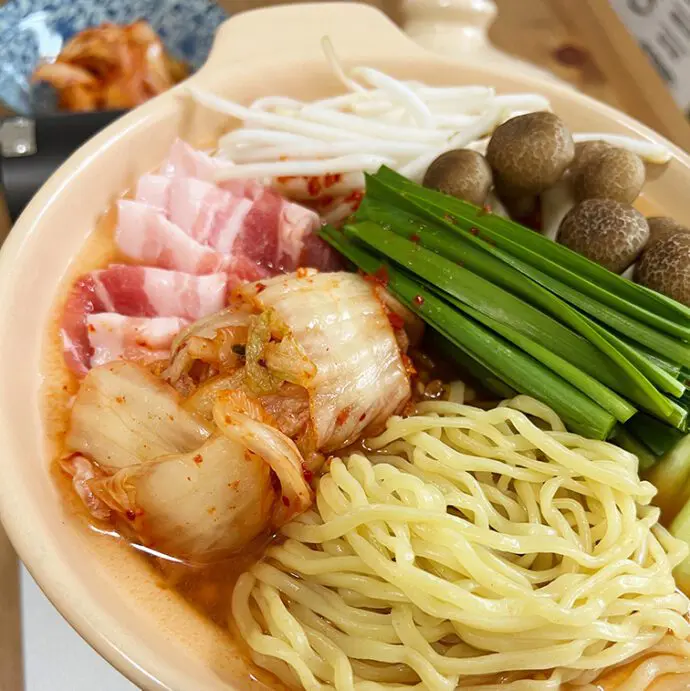
If you love the communal feel of Korean hotpot flavors but want an easy weeknight method, this kimchi hotpot is your best starting line. The broth is kimchi-forward and built for add-ins—thin-sliced meat, shimeji mushrooms, bean sprouts, and green onions—so every bite tastes layered and “complete.” A smart serving move is to treat noodles like the finale: add them early for a one-pot meal or add them later so the noodles stay springy after the vegetables and proteins have simmered.
How to make it feel especially Korean-inspired (without complicating it):
- Add extra kimchi and a bit of kimchi juice for deeper tang.
- Finish with sesame oil and scallions for aroma.
- Adjust spice by choosing a milder or hotter kimchi base.
Recipe is here: KIMCHI HOTPOT WITH RAMEN NOODLES
Korean-Style Kalbi Garlic Miso Ramen
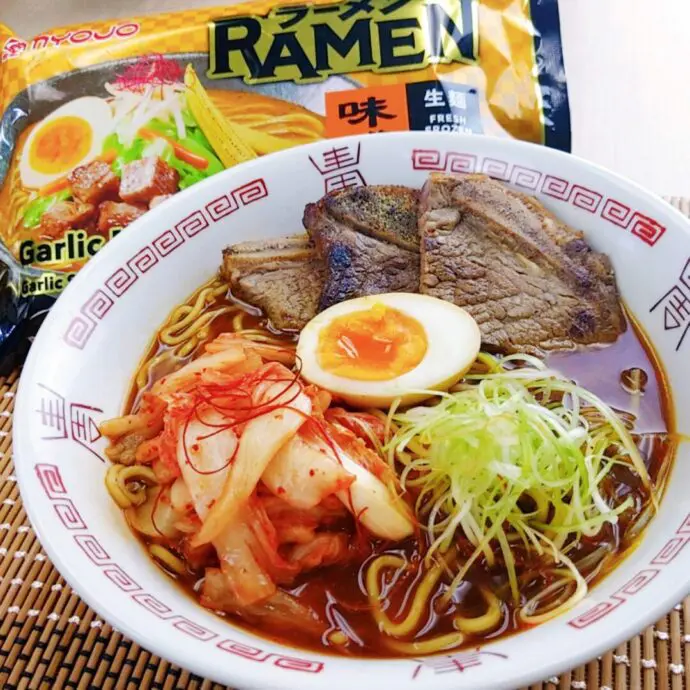
This is a clean, high-impact crossover bowl: Japanese-style garlic miso ramen, topped with Korean kalbi and kimchi. Kalbi brings sweet-savory richness, while kimchi adds acidity and heat—together they create a flavor profile that feels bold but balanced, especially when paired with a miso base.
Make it restaurant-satisfying with simple toppings:
- Add a marinated egg (ajitsuke tamago) or a soft-boiled egg.
- Use sliced green onions for freshness and crunch.
- If you want more “K-BBQ” character, add toasted sesame and a touch of gochujang to the finishing oil.
Recipe is here: KOREAN-STYLE KALBI GARLIC MISO RAMEN
■Conclusion and where to buy Myojo USA noodles
Japanese vs Korean noodles is not a “winner-take-all” comparison. In North America, the smartest noodle households usually do both:
- Japanese noodles when you want umami depth, regional variety, and a “slurpable” noodle bite.
- Korean noodles when you want fast intensity—spice, savory punch, and sauce-forward fun.
The bigger trend is that consumers are becoming more intentional: they want better texture, better customization, and more cultural specificity.
If you want the best of both worlds, the simplest strategy is:
- Choose a high-quality noodle base (texture first).
- Choose your flavor direction (Japanese broth or Korean seasoning).
- Add 3–5 toppings that make the bowl feel “restaurant-complete.”
Myojo USA is built for that strategy—especially if you want fresh, non-fried noodles as the foundation for both Japanese-style bowls and Korean-inspired twists.
To find Myojo USA noodles near you (in-store and select online options), use the store locator here:
https://www.myojousa.com/where-to-buy/
With the right noodles on hand and a clear sense of the flavors you want, you can build bowls that are both comforting and creatively cross-cultural.
Reference link:
World Instant Noodles Association — Demand Rankings (Updated May 7, 2025)
World Instant Noodles Association — Instant Noodles Trivia
InvestKOREA (KOTRA) — Exports of instant noodles hit fresh high (Date: 2024.11.04)
Bloomberg — Super-Spicy Noodles Make Former Stay-at-Home Mom a Billionaire (Dec 12, 2024)
Costco — Samyang Buldak Ramen Carbonara, Spicy Chicken (product listing)
Japan-guide.com — Ramen
Encyclopaedia Britannica — ramen
Ramen.jp (Nishiyama Seimen) — Kansui (alkaline salts) explainer
Whole Foods Market — Japanese Spicy Ramen Cup product page
Fast Company — How H Mart found success bringing Korean food to the U.S.
TIME — Denmark Recalls Popular Korean Instant Noodles Because They Are Too Spicy (Jun 2024)
Overseas sales of Korean ramyeon exceeds $1.7 bn for first time in 2022 – 매일경제 영문뉴스 펄스(Pulse)
Samyangfoods | COMPANY | SAMYANG FOOD
About | CUPNOODLES MUSEUM OSAKA IKEDA
Nongshim USA